
A look at overlapping movements across Europe, with reporting checked through 1 November 2026.
Europe’s protests are becoming difficult to fit into a single headline. Students are demanding functioning schools and affordable universities. Housing campaigners are occupying squares. Anti-corruption movements are challenging entrenched political networks. Dockworkers are refusing to let civilian ports become routine passageways for weapons.
“Gen Z protests” captures an important part of this picture: young people are setting agendas, developing their own forms of organization and making themselves heard outside established parties. Yet the label becomes much more useful when we examine the relationships between generations, institutions and movements. A student blockade, a tenants’ march and a port strike draw on different kinds of power.
Reading Common Dreams’ account of the international dockworker action on 30 October, I was struck by how closely its demands connect to arguments being made in classrooms and public squares. Who decides what public money supports? Who bears the costs of economic insecurity and war? What can people do when governments acknowledge their concerns but continue with the same policies?
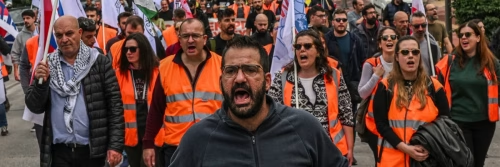
(Photo by Aris Messinis/AFP via Getty Images)
What the “Gen Z” label reveals—and what it leaves out
CIVICUS’s 2026 assessment of youth-led protests identifies recurring grievances: economic hardship, blocked opportunities, corruption and political elites who appear insulated from everyday life. It also describes decentralized organizing, collective leadership and the circulation of tactics between countries.
These features help explain why the generational framing has travelled so widely. Young participants can recognize something of their own circumstances in protests elsewhere, even when national political systems and immediate demands differ considerably.
However, age alone explains relatively little. Students working alongside their studies, young professionals considering emigration and renters unable to establish independent households face specific institutional problems. Their grievances become politically effective through organizations, alliances and sustained participation. Sharing a birth cohort does not automatically produce a shared ideology or a common political programme.
There is also a danger in allowing an attractive generational label to obscure the people marching beside students: teachers, parents, pensioners, transport workers and union members. Their involvement helps explain how a movement can survive beyond its first burst of attention.
France, Belgium and Italy: education as a struggle over the future
In France, the autumn mobilizations have brought school conditions into the centre of political debate. EL PAÍS reports demands for more teachers, smaller classes and better facilities, alongside the participation of trade unions and other social groups. In Belgium, cuts affecting French-speaking education and planned tuition increases have generated related anger.
Italian students have explicitly taken inspiration from France, while connecting education funding to opposition to military spending. The relationship between classrooms and government budgets is central: students are asking what kind of society current spending decisions are building.
Education protests deserve to be taken seriously on their own terms. A deteriorating school building or an unaffordable university place is a concrete restriction on someone’s future. When governments describe education as an investment while making access more precarious, students have good reason to question that promise.
For me, this is one of the clearest political threads running through these mobilizations: the demand for a credible future, supported by institutions that people can actually use.
Spain and Portugal: the right to live where you work
Housing makes that demand especially tangible. In Portugal, demonstrations in Lisbon and Porto have joined anger over rent with frustration over wages and everyday living costs. Euronews documented Portuguese protesters drawing inspiration from housing protests in Spain. This is a direct example of movements learning from one another across a border.
The wider European context helps explain the resonance. Eurostat’s September 2026 housing assessment, using 2025 data, found that 26.9% of EU residents aged 15–29 lived in overcrowded households, compared with 16.8% of the overall population. These figures describe different national circumstances, but they give some scale to the pressures on younger households.
The movements also extend beyond young renters. Euronews’s account of demonstrations on 24 October describes pension demands in Madrid alongside housing demands in Portugal. Public pensions and affordable homes concern different stages of life, yet both raise questions about economic security and the distribution of resources.
My reading is that housing campaigns expose a particularly damaging contradiction: people can meet the expectations placed on them—study, work, pay their bills—and still find that a stable home remains beyond reach. That experience gives an apparently technical policy field considerable political force.
Serbia and Albania: corruption, opportunity and political accountability
Serbia demonstrates the importance of persistence. The student-led movement emerged after the 2024 collapse of the railway-station canopy in Novi Sad, which killed 16 people. Protesters connected the disaster to allegations of corruption and failures of public accountability.
Nearly two years later, the movement reached an electoral breakthrough. Reuters reported Aleksandar Vučić’s concession after the 25 October parliamentary election. The UK House of Commons Library’s subsequent briefing records a parliamentary majority for the Student List and the end of the Serbian Progressive Party’s long period in government.
That outcome makes the organizational story essential. Sustaining participation through months of uncertainty requires considerably more than online enthusiasm. It also opens a new question: how can the accountability demanded in a protest movement be carried into government and maintained there?
Albania belongs firmly in this discussion. Student-led protests have raised concerns about education costs and corruption, while earlier mobilizations challenged luxury tourism development. Albanian public broadcaster RTSH’s account of Edi Rama’s responses to Reuters records both the demands for his resignation and his refusal to step down. Rama defended his electoral mandate and said he was willing to discuss education costs.
Reuters reporting republished by eKathimerini also captures students’ frustration with connections determining opportunity and with emigration appearing to offer a more plausible future. The underlying issue is substantial: what makes staying in one’s country a viable choice?
The longer roots: Greece, Slovakia and Bulgaria
The October headlines sit within a longer cycle of mobilization. In Greece, demands for accountability after the 2023 Tempi rail disaster have repeatedly brought people into the streets. In Slovakia, students’ use of pavement slogans gave the anti-government movement its “Chalk Revolution” name. The European Democracy Hub’s June 2026 review traces the continuation of both movements into this year.
Bulgaria offers another recent precedent. International IDEA’s democracy tracker records how protests against the proposed 2026 budget expanded into a broader challenge over corruption and political impunity in late 2025. Prime Minister Rosen Zhelyazkov resigned on 11 December 2025, after weeks of mobilization with strong youth participation.
The dates matter. These were movements with their own histories, rather than simultaneous reactions to a single European event. Taken together, they suggest that public anger can persist, change its immediate target and acquire new organizational forms.
Memes, chalk, keys and carnations: how protest becomes recognizable
The cultural life of these movements helps explain how they travel. Symbols condense complex arguments into something people can carry, repeat, photograph or adapt.
In France, “Bismillah, c’est les ténèbres” became a memorable example. Euronews traces the slogan to a circulating Snapchat screenshot that students interpreted as an awkward attempt by an undercover police officer to imitate their speech. That interpretation should remain attributed to students; the screenshot does not establish who wrote the message. The phrase nevertheless became a vehicle for mocking authority and its assumptions about young people.
Other protest objects have a different emotional register. Reporting from a Lisbon housing demonstration describes keys, cardboard houses and red carnations. A key makes the demand for a home immediately understandable; a carnation evokes Portugal’s democratic history. Chalk likewise allows an ordinary urban surface to become a public statement.
These objects are politically interesting because they connect everyday experience to collective action. Their accessibility helps people participate, while their visual simplicity allows images to circulate far beyond the original demonstration. Following their movement can reveal connections that a country-by-country news roundup misses.
Gaza solidarity reaches the docks
The dockworker mobilization on 30 October adds a crucial dimension: the ability to interrupt the systems through which goods and weapons move.
Common Dreams reported an international action against the genocide in Gaza, citing organizers’ announced reach of 113 ports in 22 countries. Its report foregrounds the campaign’s argument that coordinated refusals can prevent a shipment rejected at one port from simply being redirected elsewhere.
The scale needs careful description. The International Transport Workers’ Federation’s advance statement referred to more than 100 ports across 17 countries. Port Technology International reported both the ITF’s figure and the larger total given by the Italian union USB. Participation included different forms of action, from longer strikes to shorter stoppages and solidarity demonstrations. A participating port should therefore not automatically be counted as a completely closed port.
There was verified disruption. Reuters reported interrupted cargo operations at Piraeus and suspended ferry services to Greek islands. It also reported the campaign’s estimate that the action would affect 52,000 containers and cargo worth $2.8 billion, while explicitly stating that it could not independently verify that impact. Those numbers should be treated as campaign estimates, rather than an audited account of the day’s results.
The demands also reveal how much is lost when this is described solely as a foreign-policy demonstration. The Istanbul Declaration and international call for action, developed following a May meeting in Istanbul, link opposition to weapons shipments and the militarization of ports with demands for better pay, secure employment, safer conditions and protection from job losses associated with automation and AI. Türkiye’s Liman-İş was among the participating organizations.
Gaza solidarity also has a clear human-rights context. In its 26 October findings, the UN Independent International Commission of Inquiry stated that Israeli authorities and forces continued to commit genocidal acts in Gaza.
What stands out politically is the move from expressing solidarity to exercising workplace power. Dockworkers can make the relationship between ordinary commercial infrastructure and military supply chains visible. Their action also brings the consequences of war into a discussion of labour: the safety of crews, the purposes of infrastructure and workers’ say over the work they perform.
Where youth movements and labour struggles meet
The strongest connection between these movements is a dispute over priorities. Students ask why educational opportunities are narrowing. Housing campaigners ask why employment does not secure a home. Anti-corruption protesters ask why public institutions appear to serve well-connected networks. Dockworkers ask why their workplaces should facilitate wars while their own conditions remain insecure.
My reading is that these are related arguments about democratic control: who gets to make consequential decisions, and whose experience counts when those decisions are made?
This connection does not require every participant to agree about every issue. Coalitions can emerge around a school budget, an eviction, an investigation or a weapons shipment. Their strength depends on how effectively they translate a shared concern into a specific demand and a sustained capacity to act.
The organizational differences are useful here. Student assemblies can create space for new participants and collective decisions. Housing campaigns can turn private experiences of insecurity into public claims. Unions bring workplace relationships and the capacity to withdraw labour. Each raises possibilities that the others may find harder to achieve alone.
There are also real tensions. Electoral victories create responsibilities that street mobilization does not resolve. A spectacular demonstration may leave little organization behind. A strike can attract international attention while participation varies sharply between workplaces. Evaluating these movements requires attention to what remains after the images stop circulating.
For the coming months, I would watch three things: concrete improvements in education, housing and working conditions; credible mechanisms for investigating abuses and corruption; and durable relationships between students, communities and organized labour. Those developments would show how far protest is changing people’s ability to shape their lives.
Across Europe, the movements discussed here are making claims on the future in remarkably practical forms: a usable classroom, an affordable home, an accountable institution and a workplace whose workers have a voice. The dockworker action adds an international dimension to those claims, insisting that the purposes served by Europe’s infrastructure are themselves a matter for public argument and collective action.
Discover more from Erkan's Field Diary
Subscribe to get the latest posts sent to your email.