
Such a nice country, and now comes political turmoil. I hope it’s resolved soon.
The “coup” allegations in Poland concern a struggle over control of the Constitutional Tribunal—not a reported military attempt to overthrow the government. A disputed move to suspend the tribunal’s leadership on October 30 triggered police deployments, protests and intervention by President Karol Nawrocki. The tribunal’s existing leadership and the president accuse Prime Minister Donald Tusk’s side of an unlawful takeover; the government-backed judges say they are restoring the court’s lawful functioning. The safest description, as of November 1, is a serious constitutional crisis, with the legality of the takeover unresolved—not an established coup.[politico][rmb.reuters][laveulliure]
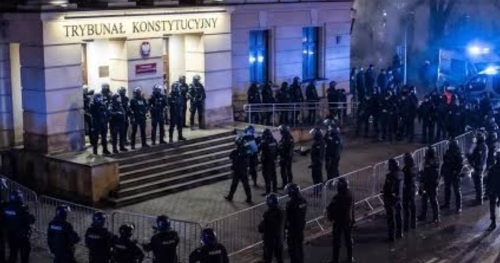
What happened?
- On October 30, judge Anna Korwin-Piotrowska ordered the one-month suspension of tribunal president Bogdan Święczkowski and vice-president Bartłomiej Sochański. She asserted that she should take over the court’s leadership on the basis of her judicial seniority. Her authority to do so—and even her status as a tribunal judge—is disputed by the existing leadership.[politico][notesfrompoland]
- She accused Święczkowski of preventing parliament-elected judges from taking up their duties and overseeing irregularities in the assignment of judges to cases. Those are the stated grounds for her action, not findings accepted by both sides.[notesfrompoland]
- Justice Minister and Prosecutor General Waldemar Żurek separately submitted five requests to lift the two officials’ judicial immunity, supported by 50 volumes of case files. Requests to remove immunity are not themselves criminal charges or proof of wrongdoing. Żurek defended Korwin-Piotrowska as a legally appointed judge and said the government had not directed her decision.[politico][kyivindependent]
- Riot police surrounded the tribunal as opposition supporters gathered. Reporting documents police preventing Święczkowski from entering the grounds after supporters cut through a fence; three people were detained during disturbances. Thus, this was more than a purely verbal dispute, although the police presence alone does not establish a coup.[notesfrompoland][kyivindependent]
- Nawrocki interrupted his journey to Senegal, returned to Warsaw and entered the tribunal. He subsequently denounced a “forceful takeover of a constitutional body” and called consultations with political leaders.[notesfrompoland]
Who is making the coup allegation?
The accusation comes principally from Święczkowski’s camp, the tribunal’s existing leadership, and politicians associated with the opposition Law and Justice party, or PiS. The tribunal’s X account declared: “All persons participating in these actions are committing the crime of a coup d’état.” It also claimed that the tribunal’s website had been unlawfully taken over and that Korwin-Piotrowska was not a tribunal judge.[notesfrompoland]
That last detail matters: the institution’s website and its social-media account were communicating competing claims of authority. Statements attributed to “the Constitutional Tribunal” therefore need to be read as part of the dispute—not necessarily as the position of an uncontested, unified court.[notesfrompoland]
Nawrocki has framed the events as a forced takeover by Tusk’s side. Tusk, by contrast, has said the tribunal will operate in accordance with the law. Neither position settles the underlying legal question.[rmb.reuters][thenewstribune]
Why has the dispute become so difficult to resolve?
There are two connected layers.
1. The older dispute over PiS-era appointments
The controversy is not simply an invention of the current government. In its 2021 judgment in Xero Flor w Polsce v. Poland, the European Court of Human Rights found that a tribunal panel had not been a “tribunal established by law” because it included a judge elected to a seat that had already been filled. The judgment documented serious irregularities surrounding the appointment of three judges in 2015 and the authorities’ disregard of relevant Constitutional Court rulings.[hudoc.echr.coe][hudoc.echr.coe]
That provides a substantial legal basis for criticism of the tribunal’s PiS-era composition. It does not, however, automatically establish that any particular method used by Tusk’s allies to change its leadership is lawful.
2. The newer dispute over who can become a judge—and take charge
Parliament has elected new judges, but Nawrocki has refused to swear in several of them, including Korwin-Piotrowska. Those judges and their supporters maintain that they can nevertheless exercise their functions; their opponents reject that claim. The tribunal’s existing leadership has prevented the disputed appointees from hearing cases.[notesfrompoland][aljazeera]
The immediate legal questions therefore build on one another:
- Was Korwin-Piotrowska validly able to exercise the office of tribunal judge?
- If so, did she have authority to suspend its president and deputy?
- Could she then assume the leadership herself?
- On whose lawful instructions were access to the building and the tribunal’s administration being controlled?
The reporting establishes that these questions are contested; it does not provide a definitive judicial resolution.[politico][notesfrompoland][rti.org]
How seriously should we take the “coup” label?
Seriously as an allegation of unlawful institutional seizure, but not as an established description of events. The reports do not describe the military taking power, the elected government being overthrown or the president being removed. They describe rival groups claiming lawful authority over a constitutional institution, backed by opposing political camps, with police controlling access to the building.[politico][notesfrompoland][timesnownews]
The distinction is important: the absence of a military coup does not make an unlawful takeover of a court harmless or impossible. Equally, describing the tribunal’s prior politicisation does not by itself justify bypassing legal procedures to replace its leadership.
What remains to be established is whether the suspensions and transfer of authority had a valid legal basis, and whether state coercive power was used to enforce an unlawful change. Until that is resolved, headlines announcing a “coup in Poland” turn one side’s accusation into a conclusion the available evidence does not yet support.[politico][laveulliure][rti.org]
Discover more from Erkan's Field Diary
Subscribe to get the latest posts sent to your email.