
A new phase in the Israel–Hezbollah confrontation appears to be emerging in southern Lebanon: the growing use of fiber-optic first-person-view drones, or FPV drones, by Hezbollah. These small, low-cost systems are not decisive weapons on their own, but they have exposed a significant vulnerability in Israel’s battlefield defenses, especially against short-range, low-flying threats that are difficult to jam or detect.
The basic technology is straightforward. Unlike conventional drones that rely on radio frequencies, GPS, or other wireless links, fiber-optic FPV drones remain physically connected to their operators through a thin cable. This allows the drone to transmit video and receive commands without emitting a radio signal. As AP explains, the cable can be as thin as dental floss, making the drones difficult to detect and “impossible to electronically jam” in the usual sense. (AP News)
The system has already been used extensively in the war in Ukraine, where both Russian and Ukrainian forces have adapted drones to operate in heavily jammed environments. Hezbollah’s adoption of the same technology suggests that battlefield innovations are now moving quickly across conflict zones. The Los Angeles Times, carrying AP reporting, notes that Israeli officials believe Hezbollah’s fiber-optic drones can be locally assembled from off-the-shelf parts, small explosives, and commercially available wire. (Los Angeles Times)

Why these drones matter
For Israel, the challenge is not that Hezbollah has suddenly gained technological superiority. Israel still has overwhelming advantages in airpower, intelligence, surveillance, and firepower. The issue is more specific: a relatively cheap weapon has found a gap in a sophisticated defense architecture.
Many Israeli systems were built around intercepting rockets, missiles, larger drones, and radio-controlled threats. Fiber-optic FPV drones evade part of that logic. Because they do not depend on a wireless signal, standard electronic warfare tools cannot easily cut the connection between operator and drone. They also fly low, move fast, and have a small visual and thermal signature. (AP News)
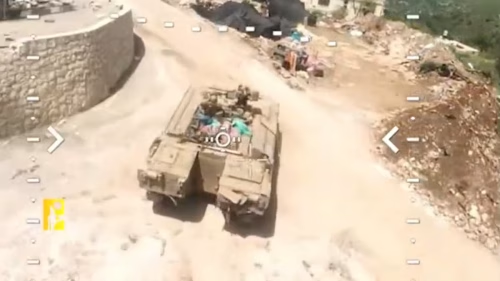
Recent reports suggest that Hezbollah has used these drones against Israeli soldiers, armored vehicles, and positions in southern Lebanon and along the border. AP reported that drone attacks had killed Israeli personnel and injured others in late April, while Hezbollah has circulated videos of attacks through its media channels. (AP News)
This video dimension is important. The footage is not just battlefield documentation; it is also propaganda. FPV videos offer the viewer the perspective of the drone itself, turning tactical strikes into dramatic visual narratives. In that sense, the drones function both as weapons and as media objects.

Israel’s improvised defenses
Israel has responded with a mix of emergency adaptation and accelerated technological development. One visible response has been the use of physical netting over vehicles and military positions. JNS, citing Israeli officials, reported that roughly 158,000 square meters of netting had already been supplied to the IDF, with another 188,000 square meters under procurement. (Israel & Jewish News – JNS)
This does not mean Israel is helpless, as some pro-Hezbollah commentary suggests. But the use of nets does indicate that existing electronic and air-defense systems are not enough against this particular threat. Defense firms are now reportedly racing to develop countermeasures, including smart rifle sights, interceptor drones, improved sensors, and other close-range defenses. Breaking Defense reported that Israeli industry and the military are treating the FPV drone threat as an urgent operational problem. (Breaking Defense)
Israeli analysts quoted in several reports describe this as a “gap” rather than a collapse. The distinction matters. Hezbollah’s drones can cause casualties, disrupt movement, and impose psychological pressure on troops, but they do not by themselves overturn Israel’s broader military advantage.
A new asymmetric pattern
The most significant implication may be doctrinal. Hezbollah has long relied on asymmetric tactics: rockets, tunnels, anti-tank missiles, drones, and information operations. Fiber-optic FPV drones fit neatly into this repertoire. They are cheap, expendable, and difficult to counter with expensive centralized systems.
According to JNS, Israeli security analysts see Hezbollah’s transition to fiber-optic FPV drones as a deliberate imitation of innovations from the Russia–Ukraine war. The same report says the drones have become one of Hezbollah’s most prominent weapons against Israeli troops since March 2026. (Israel & Jewish News – JNS)
The cost asymmetry is also politically important. A drone costing a few hundred dollars can force a military to spend far more on detection, protection, interception, and operational caution. This is one of the defining features of contemporary drone warfare: the tactical effect is not only physical destruction, but also the burden imposed on the adversary’s decision-making cycle.

The limits of the technology
Still, the new drones should not be overstated. Fiber-optic FPV drones have important weaknesses. Their cables can tangle, snap, or be affected by terrain, trees, buildings, wind, or other drones. Their range is limited compared with missiles or long-range unmanned systems. They also require trained operators and favorable local conditions. AP and Al Jazeera both note that weather, obstacles, and cable fragility can limit their effectiveness. (AP News)
This means the drones are better understood as a tactical innovation within a broader conflict, not as a strategic game-changer on their own. They may make Israeli ground operations more costly and complicated, but they do not remove Israel’s ability to strike Hezbollah infrastructure, conduct surveillance, or operate in Lebanese airspace.
A conflict continuing despite ceasefire diplomacy
The drone issue is unfolding amid a fragile and violent diplomatic environment. Reuters reported in mid-May 2026 that Israel and Lebanon had agreed to extend a ceasefire by 45 days after U.S.-facilitated talks, while AP and other outlets reported continuing Israeli strikes and Hezbollah attacks despite ceasefire arrangements. (Reuters)
This context matters because Hezbollah’s drone campaign is not simply a technical story. It is part of a wider struggle over deterrence, southern Lebanon, Israeli security demands, Hezbollah’s future role, and the Lebanese state’s limited ability to control the conflict. The drones give Hezbollah a relatively low-cost way to keep pressure on Israeli troops while projecting an image of adaptation after earlier losses.

What to watch next
Three developments will determine whether fiber-optic FPV drones remain a disruptive nuisance or become a more serious operational constraint.
First, Israel’s counter-drone response: if Israeli forces rapidly deploy reliable detection and interception systems, the window of Hezbollah advantage may narrow.
Second, Hezbollah’s production capacity: if the group can produce or import these drones at scale, they could become a persistent feature of the northern front.
Third, tactical integration: the biggest danger may come not from individual drones but from their use alongside artillery, anti-tank weapons, surveillance drones, and staged “double-tap” attacks against rescue or repair teams.
For now, the safest conclusion is this: Hezbollah’s fiber-optic FPV drones have not changed the overall balance of power between Israel and Hezbollah, but they have changed the texture of the battlefield. They show how quickly lessons from Ukraine are being absorbed elsewhere, and how inexpensive systems can force even technologically advanced militaries into improvised adaptation.
In modern warfare, the next major problem may arrive not as a missile, jet, or tank, but as a small drone trailing a nearly invisible thread.
Discover more from Erkan's Field Diary
Subscribe to get the latest posts sent to your email.