
Research cut-off: 25 October 2026.
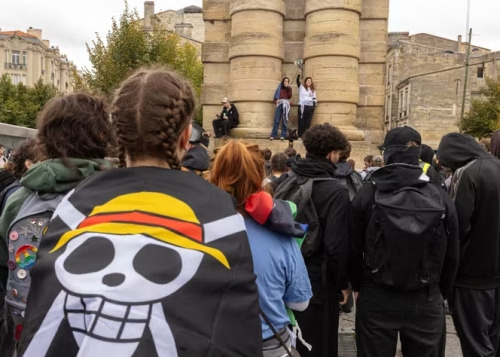
A strange Snapchat greeting becomes a slogan. A cartoon pirate’s flag appears in demonstrations thousands of kilometres apart. A childhood soundtrack accompanies school blockades. A wetland bird becomes an emblem of resistance to luxury development. These examples suggest that understanding contemporary protest requires attention to the cultural materials through which people make their grievances visible.
The central argument of this report is that popular culture supplies protesters with a shared vocabulary, portable objects and familiar ways of acting together. A costume can stage an argument about power. A joke can expose a stereotype. A song can turn a gathering of strangers into a collective performance. The political significance lies in what participants do with the reference, rather than simply in its presence.
The report begins with the French student protests discussed in the NTV article that prompted this inquiry, then compares them with recent and historical cases elsewhere. It covers internet humour, manga and television, music and fandom, food and animals, everyday objects and embodied performance.
1. What the French slogan does—and what remains unverified
“Bismillah, c’est les ténèbres” combines the Arabic expression “in the name of God” with the French “it’s the darkness.” Its protest meaning depends on a circulating story: students received awkwardly worded Snapchat messages seeking access to groups organising school blockades. They suspected someone was impersonating young people, possibly on behalf of the police. Screenshots became material for ridicule. Crucially, the New York Times report republished by The Indian Express explicitly says the messages’ origins could not be verified.
According to The Independent’s account, protesters interpreted the wording and its accompanying references as a caricature of French-Arabic youth speech. Repeating the phrase therefore mocks an outsider’s imagined version of youth culture and challenges the association of Arab identity with vandalism. The relevant object is the whole communicative episode: the suspicious message, the screenshot, its humorous recirculation and its subsequent appearance on placards.
This is also a useful limit case for interpretation. The Times reports both the unconfirmed police attribution and objections from some Muslims to the phrase’s reuse. A slogan can be effective for participants while remaining troubling to other audiences. Its adoption does not make its origin certain or its meaning universally shared.
Analytical reading: the phrase functions like a test of cultural membership. Recognising why it sounds wrong becomes a way of recognising one another. However, familiarity with a joke cannot authenticate anyone’s identity, and the humour should not be treated as evidence that the suspected infiltration actually occurred.

2. Beyond the slogan: the French protest repertoire
The political context should remain visible throughout. The New York Times account describes demands for improved school facilities, more teachers, smaller classes and less intensive schedules, alongside anger at the police response. The cultural practices below are ways of participating in that conflict; they do not explain it on their own.
Fast food meets antifascism
“Tasty Crousty antifascisti” grafts the name of a fast-food brand onto a familiar antifascist chant. Politis documented the slogan on 6 October; Revue XXI subsequently described its relationship to “Siamo tutti antifascisti.” This is an unusually compact example of remix: a recognisable political cadence carries an everyday commercial reference.
The juxtaposition invites questions about cultural legitimacy. Who decides which language is appropriate for political participation? Can a cheap meal or a brand associated with ordinary youth consumption become a vehicle for political identification? Those questions are more revealing than dismissing the chant as evidence that demonstrators are unserious.
“Six-seven” meets May 1968
Politis also recorded a “mai 6/7” reference, connecting the internet’s “six-seven” joke with May 1968. The older protest memory supplies historical weight; the contemporary reference gives participants a recognisable twist. This is a particularly useful example of how a meme can adapt inherited political language without requiring a literal explanation of the original joke.
Importantly, the presence of a May 1968 reference does not demonstrate that today’s movement has the same organisation, social composition or ambitions. It establishes that an earlier revolt is available as a cultural resource. Historical analogy is itself part of the protest performance.
Aura battles, choreography and the staged encounter
Revue XXI’s reporting from Paris describes “aura battles”: playful contests of gesture and presence, including a participant in an inflatable shark costume. It also documents dancing before riot police and a collective countdown that ends in a prank rather than an action. Such moments are filmed and circulated as short videos.
These practices make the encounter with authority performable for several audiences at once: the people present, the person holding a phone and viewers who encounter the clip later. The interpretation proposed here is that their power comes partly from changing the expected script of confrontation. The reporting does not establish that these performances consistently prevent police intervention.
Manga, superheroes and cinematic authority
Le Monde’s manga coverage documents references to One Piece, Naruto, Dragon Ball and The Rose of Versailles. It identifies the Akatsuki’s dark cloaks with red clouds as a visible costume choice. These fictional worlds offer characters through whom participants can express rebellion, loyalty, justice or resilience.
In a separate example, Le Monde reported a Luffy-costumed participant carrying a keffiyeh. The combination matters: participants can attach a specific political commitment to a widely shared fictional identity. A costume need not have one fixed political meaning.
Inflatable animals and the travelling protest image
The same Le Monde report describes a French participant whose inflatable frog costume was inspired by a Portland protester. This provides a concrete instance of a demonstrator acknowledging a foreign reference. It is stronger evidence of transmission than merely noticing similar costumes in two countries.
The inflatable also invites a different analytical question from the fictional hero. Its exaggerated size, movement and comic appearance can create a striking contrast with formal police equipment. Whether audiences interpret that contrast as brave, ridiculous, threatening or sympathetic remains a question for evidence about reception.
A YouTube-era soundtrack becomes a blockade anthem
La Dépêche traces the revival of Nodey’s “No Title” to its original use in Cyprien’s 2015 short film Technophobe. The track became a recurring accompaniment to blockade and demonstration videos on TikTok and Instagram. Its composer acknowledged the unexpected revival.
The important cultural resource here is shared media memory. A soundtrack can acquire political meaning through its new use, even when it was not composed for protest. Researchers should distinguish that process from a song whose original lyrics already articulate a political programme.
Older protest music continues alongside platform culture
Politis’s street report places a chant associated with punk band Bérurier Noir, “La Marseillaise” and contemporary music within the same demonstration. Le Monde also documents the presence of activist DJs and musicians. These observations complicate any account in which internet culture simply displaces older repertoires. The march is a meeting place for different musical memories, political traditions and modes of participation.
3. International comparisons: what travels, and what remains local?
The following cases are comparisons, not claims that every item appears in the current French movement. Their value is that they reveal different ways cultural references become politically useful.
| Reference or practice | Documented setting | What the comparison helps explain |
|---|---|---|
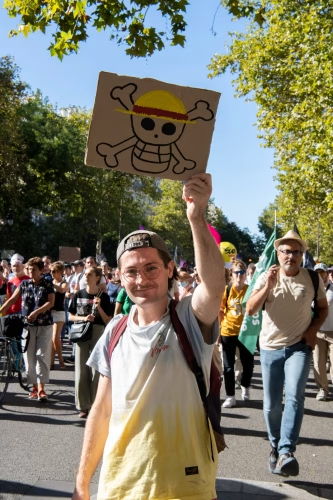
| One Piece pirate flag | Indonesia, Nepal and Madagascar, 2025; France, 2026 | A fictional emblem becomes a reference shared across movements. |
| Hamtaro and the three-finger salute | Thailand, 2020 | Childhood entertainment supplies satire and a repeatable gesture. |
| K-pop light sticks | South Korea, December 2024 | Fandom objects and performance practices enter civic mobilisation. |
| Penguins and “chapulling” | Türkiye, Gezi protests, 2013 | Protesters rework media failures and hostile labels. |
| Pikachu costume | Antalya, Türkiye, March 2025 | A recognisable character attracts attention and subsequent imitations. |
| Inflatable frog | Portland and other US protests, 2025 | Comic appearance contests representations of protesters. |
| Flamingo | Albania, 2026 | A local ecological relationship becomes a movement emblem. |
| Cockroach identity and games | India, 2026 | A reclaimed insult extends into satirical digital production. |
| Watermelon imagery | Palestinian solidarity, especially 2023–24 | Colour, food and emoji connect different media and audiences. |
| Red robes, collective choreography, umbrellas and book covers | Several distinct movements discussed below | Objects and bodies can carry an argument without a long slogan. |
The pirate flag: a shared story without a single programme
ABC’s comparative reporting connects One Piece imagery with protests in Madagascar and Indonesia. A research essay by Zezhou Yang at the National University of Singapore examines its use in Nepal, including “wanted” posters adapted to depict political leaders. This is more than displaying a purchased flag: participants borrow a fictional world’s formats and rewrite their contents.
The analytical temptation is to infer a unified international movement. A more careful interpretation is that the flag offers a shared narrative resource through which different grievances become mutually recognisable. Similar imagery does not establish coordinated organisation, identical demands or agreement about what political change should follow.
Thailand: a hamster song and a gesture of defiance
Prachatai’s July 2020 report describes protesters circling Bangkok’s Democracy Monument while singing a rewritten Hamtaro theme. The adaptation satirised public officials’ consumption of taxpayers’ money. Participants also brought hamster toys and wore costumes. At the same gathering, the three-finger salute associated with The Hunger Games accompanied the national anthem. Amnesty International independently documents the movement’s use of Hamtaro, Harry Potter references and the salute.
The two borrowings work differently. The song requires collective timing and adaptation; the salute makes a political position legible through a simple bodily act. Both invite participation through something already familiar.
South Korea: fandom objects enter the square
Reuters documented customised K-pop light sticks at demonstrations seeking President Yoon Suk Yeol’s impeachment in December 2024. Its 21 December report likewise records demonstrators waving them to K-pop music. The object’s prior life in fandom matters: participants bring a familiar form of collective visibility into a new setting. This does not imply an endorsement by the musicians whose merchandise is present.
Gezi: the media failure and the insult become materials
The Gezi protests offer a particularly useful precedent. Seçil Dağtas’s anthropological account examines humour around CNN Türk’s penguin documentary during the protests. The Ethical Journalism Network also identifies the penguin as an emblem used to ridicule media self-censorship. Meanwhile, ABC’s contemporary account of “chapulling” describes the inventive reuse of language and objects.
The comparison with France is precise: the grievance itself generates reusable cultural material. Researchers need to ask who supplies a movement’s symbols. Sometimes the answer is an entertainment industry; sometimes it is a broadcaster or political opponent whose conduct protesters turn against them.
Pikachu and the frog: visibility, vulnerability and verification
A real Pikachu-costumed participant appeared in the March 2025 protests in Antalya. Reuters verified footage and distinguished it from subsequent AI-generated pictures; AFP also investigated a synthetic image. A genuine event can therefore generate fabricated visual “evidence.” Cultural resonance and documentary reliability require separate assessment.
In Portland, AP reported that Seth Todd’s frog costume inspired other inflatable outfits at US protests in 2025. Todd explicitly connected the costume with challenging portrayals of demonstrators as violent. AP also reported an officer spraying a chemical agent into its air vent. Humour can contest a narrative while leaving its performer exposed to force.
Albania: a bird stands for a threatened place
In Ami Xherro’s participant account in The Brooklyn Rail, Albania’s “Flamingo Revolution” links opposition to elite coastal development with wider anger about government. Le Monde’s reporting also explains the flamingo’s relationship to threatened natural environments. Unlike an imported fictional character, the bird refers to the place under dispute. The comparison shows why a similar-looking animal motif may have an entirely different origin and political function.
India: reclaiming the cockroach, then making it playable
AP’s June 2026 coverage describes the Cockroach Janata Party as a satirical movement reclaiming a disparaging label and moving from online humour into street protest. By October, Reuters reported protest-inspired games in which navigating police barricades becomes playable satire. The movement illustrates a reverse journey as well: street experiences become material for new popular cultural artifacts. The description of the game does not establish its effect on participation.
Watermelon and milk tea: everyday consumption as a political vocabulary
AP documents watermelon imagery across Palestinian-solidarity demonstrations and online posts. Its red, green, white and black evoke the Palestinian flag. NPR reporting republished by Iowa Public Radio discusses both the imagery and activists’ concerns about content moderation. The evidence supports its use as an attempted workaround; it does not show that a watermelon emoji reliably defeats moderation systems.
A different food-based idiom emerged in the Milk Tea Alliance documented by Reuters in 2020, linking online solidarity among people in Thailand, Taiwan and Hong Kong. Food can offer an accessible vocabulary for political connection, but shared consumption should not be mistaken for a complete account of the participants’ political differences.
Feminist protest: fictional costume and newly created choreography
TIME documented demonstrators wearing red robes and white bonnets inspired by The Handmaid’s Tale in Washington in 2017. The costume translates a dispute about rights into a dystopian image. It asks an audience to understand present concerns through a familiar imagined future.
Chile’s LASTESIS illustrates a different route. Its Un violador en tu camino became a widely repeated feminist performance in 2019, as documented by TIME’s account and Reuters. Here an activist-created performance itself becomes a circulating cultural form. Protest both borrows culture and produces it.
Umbrellas, books and saucepans: ordinary objects make arguments
AP’s retrospective on Hong Kong’s 2014 Umbrella Movement recalls umbrellas used against pepper spray. A practical object subsequently supplied the movement’s name. In another configuration, the V&A documents book-shaped shields originating in Italian student protests in 2010 and subsequently used elsewhere. Their covers made the confrontation visually interpretable as an attack on culture or education.
France’s 2023 saucepan protests add sound to the comparison. These objects do not need fictional origins to acquire cultural force. Their familiarity makes their altered use legible; their practical properties help determine what protesters can do with them.

Selected scholarly and curatorial references
- Bennett, W. L., & Segerberg, A. (2012). The logic of connective action: Digital media and the personalization of contentious politics. Information, Communication & Society, 15(5), 739–768.
- Dağtas, S. (2013, October 31). The politics of humor and humor as politics during Turkey’s Gezi Park protests. Fieldsights, Society for Cultural Anthropology.
- Flood, C., & Grindon, G. (2014, March 21). What are disobedient objects? Victoria and Albert Museum.
- Milner, R. M. (2013). Pop polyvocality: Internet memes, public participation, and the Occupy Wall Street movement. International Journal of Communication, 7.
- Yang, Z. (2025, December 12). Can the One Piece flag in Nepal’s Gen Z protest be an inter-Asia referencing practice? ARIscope, Asia Research Institute, National University of Singapore. Research commentary.
Discover more from Erkan's Field Diary
Subscribe to get the latest posts sent to your email.