
This is an update to my 8 October 2026 post.
I feel a bit pessimistic. This scale of protests mostly brings in a more conservative/reactionary government. Let’s see how this will go.
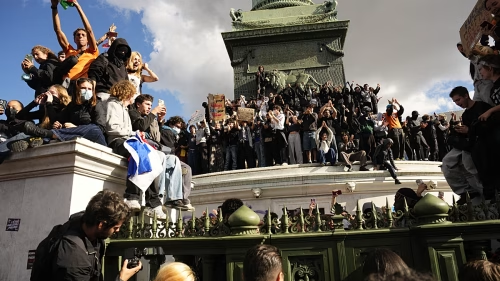
French Student Protests After 8 October 2026
Since 8 October, the lycée movement has not simply continued at the same level: school blockades have declined, but the conflict has broadened into a much larger anti-government mobilisation around education, public services, inequality and the cost of living. The key sequence was a fifth student-led national day on 13 October, followed by a cross-movement mobilisation on 17 October involving students, unions, Yellow Vests, employees and other groups.[1][2][^3]
The best reading of the scale is therefore twofold. The specifically school-based movement was receding institutionally by 13 October—214 establishments closed versus 224 on 8 October and 800 on 6 October—but street participation remained substantial and then expanded sharply when student demands merged with broader social grievances.[4][5][^2]
What happened after 8 October
9–12 October
Blockades and local demonstrations continued, although the Education Ministry reported fewer complete closures. On 12 October, 130 of France’s roughly 3,700 lycées were closed, down from 172 on the preceding Friday; the ministry nevertheless said violence was intensifying even as closures declined.[6][7]
The government began implementing its most visible concession: a promise to deploy 3,000 substitute teachers, initially focused on the institutions facing the worst shortages. Student organisations dismissed this as inadequate compared with their demand for a €10 billion education plan and wider structural reforms.[7][8]
13 October: “Act V”
The fifth national day drew sharply disputed counts: the Interior Ministry reported 161,500 participants nationwide, including 41,500 in Paris, while student and lycée organisations claimed 480,000. Authorities counted 214 school closures; the ministry said 94.2% of lycées were open, although student organisations reported extensive university disruption and around 360 actions outside Paris.[9][5][^4]
Participation was geographically broad. Official counts included 11,000 in Lyon, 7,300 in Rennes and 3,800 in Marseille, while organiser estimates—especially in Marseille—were much higher. Students used this mobilisation to call supporters into the broader 17 October action.[1][9]
14–16 October
President Emmanuel Macron acknowledged that young people had “legitimate” concerns and asked the government for concrete responses within weeks, while arguing that the movement was being politically exploited and transformed into urban violence. By 14 October, the government said 2,000 of the promised 3,000 substitute teachers had been assigned, but no settlement had been reached on the movement’s larger demands.[10][11]
Local blockades and spontaneous marches continued in places including Bordeaux, Lille and Aubervilliers, but the strategic centre of gravity shifted toward a “convergence of struggles” on 17 October.[12][2]
17 October: convergence and escalation
The 17 October action was much larger than the student-only mobilisation. The Interior Ministry counted about 550,000 participants across roughly 110 marches, including 110,000 in Paris; organisers and the CGT estimated about 800,000 nationally. Official city counts included about 20,000 each in Lyon and Nantes, 15,000 in Strasbourg, 12,000 in Rennes and 7,000 in La Rochelle.[13][14][15][3]
This was no longer solely an education protest. It brought together lycée and university students, trade unions, Yellow Vests, workers, climate activists and anti-fascist groups around the cost of living, fuel prices, deteriorating public services and educational conditions.[16][3][^17]
The overwhelming majority marched peacefully, but violent groups engaged police, looted shops and attacked public or municipal buildings in several cities. Provisional arrest and injury counts changed rapidly: authorities initially announced 1,200 arrests and 150 injured officers, then raised the totals on 18 October to at least 1,800 arrests and more than 500 injured police, gendarmes and firefighters.[2][15][18][3][^19]
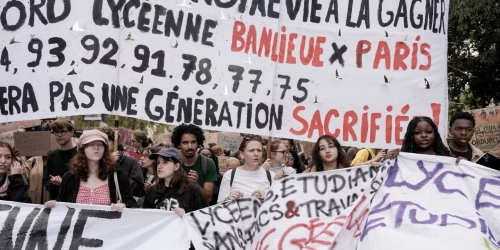
Why protests persist
Partial concessions, structural demands
The deployment of replacement teachers addresses only one immediate grievance. Protesters are also demanding smaller classes, manageable timetables, repairs to deteriorating buildings, additional school staff, abolition or reform of Parcoursup, and a €10 billion investment plan. These demands concern long-standing inequalities and the overall resourcing of public education, not an issue that 3,000 substitutes can settle quickly.[20][21][^7]
A credibility gap
The government promised consultation and measures by the end of October, while students argued that they had already stated their demands and that consultation without firm budget commitments was delaying action. The government’s proposed education budget increase and deployment announcements have therefore not yet produced sufficient confidence among organisers that structural change will follow.[22][23][21][24]
Policing became a grievance
The policing of blockades and demonstrations has helped sustain anger. A teenager lost a hand after handling a police stun grenade, use of that grenade type was suspended for student demonstrations, and the police watchdog opened multiple investigations into alleged misconduct. By 14 October, official cumulative figures listed 248 students, 149 education personnel and 937 police officers injured during the student unrest.[3][21][^11]
The movement found allies
Teachers, parents, university students and trade unions joined because staffing, buildings and public-service decline affect more than lycée pupils. The 17 October mobilisation then connected those concerns to inflation and living standards, giving the movement a wider social base even as the number of fully closed schools fell.[25][2][^3]
Political timing
The unrest is unfolding in the final months of Macron’s presidency and during the emerging presidential campaign, increasing its political salience. Student claims about unequal opportunities, poorly resourced schools and public spending have consequently become a vehicle for wider dissatisfaction with the government.[26][20][^25]
Scale in perspective
| Date | Character | Official count | Organiser count | Institutional disruption |
| 6 October | First major national convergence around students | 266,000 | 450,000 | About 800 establishments later used as comparison baseline[^5] |
| 8 October | Fourth national mobilisation | 71,500 | More than 130,000 | 224 establishments closed; roughly 96% open[27][28] |
| 13 October | Fifth student-led mobilisation | 161,500 | 480,000 | 214 establishments closed; 94.2% of lycées open[4][9] |
| 17 October | Broader cost-of-living/public-services convergence | 550,000 | 800,000 | About 110 marches; participation no longer measured mainly through lycée closures[14][3] |
The competing counts should not be averaged: they are produced by actors with different methods and incentives. The defensible range for 17 October is 550,000–800,000, while the 13 October student mobilisation lies between 161,500 and 480,000 depending on source.[2][13]
Analytical assessment
Calling the whole sequence “riots” obscures its composition. It is more accurate to distinguish a largely peaceful mass protest movement; disruptive school and university blockades; and smaller violent or opportunistic groups involved in clashes, vandalism and looting.[19][3][^2]
The movement’s school-based intensity appears to be past its early-October peak if measured by closures. Yet its political and street-mobilisation scale has increased because education grievances now operate as the trigger for a broader coalition around social inequality and declining public services.[4][3][^2]
The immediate unknown is what survives the Toussaint school break. A durable next phase would require student organisations and allied unions to convert the very large but heterogeneous 17 October turnout into common, negotiable demands; otherwise, fragmentation and the public focus on violence may weaken the education campaign despite its wider resonance.[1][2]
All images from the Wikipedia page


References
- Mouvement lycéen : à l’approche des vacances scolaires, les élèves mobilisés en appellent au relais des étudiants et des « gilets jaunes » – RécitLes manifestations ont rassemblé entre 161 500 et 480 000 personnes mardi dans toute la France …
- October 17 French protests: Crowds marched through the … – NewsOn Saturday, 800,000 people took to the streets according to organizers, while Interior Minister…
- Students, trade unions and Yellow Vests set to protest … – Around 550,000 people had participated in the demonstrations across the country, Interior Minister L…
- Mobilisation lycéenne : 480 000 personnes ont manifesté … – Dans un communiqué, le ministère de l’Éducation nationale déclare que 94,2 % des lycées sont ouverts…
- lindependant.fr · 2026/10/13 · direct-blocageREPLAY. Mouvement des lycéens : près de 500 000 personnes ont … – Environ 480 000 personnes ont manifesté partout en France mardi, nouvelle journée de mobilisation de…
- Des lycées perturbés, Macron appelle au calme – A la veille d’une nouvelle mobilisation nationale des lycéens, des blocages persistent dans plusieur…
- France braces for fresh student demonstrations as Macron calls for … – The government last week promised to deploy about 3,000 substitute teachers in the coming days to re…
- Demonstrations backing France’s protesting students … – On Monday, Macron had urged restraint from protesters, saying the issues “deserve time, consultation…
- Mobilisation des lycéens : 161.500 manifestants en France selon le … – ## Lycéens et étudiants ont de nouveau manifesté en nombre à travers la France, mardi 13 octobre, av…
- French president acknowledges young people’s concerns amid high school protests – The government has assigned 2,000 of the 3,000 substitute teachers it had pledged to deploy, Bregeon…
- Macron asks government to come up with ‘concrete … – Macron believes the students waging three weeks of protests that have closed many schools have “legi…
- Mobilisation du 17 octobre : interdiction de manifester … – Les principales organisations de jeunesse mobilisées depuis mi-septembre pour de meilleures conditio…
- Mobilisation du 17 octobre : “Ceux qui ont cassé, attaqué les … – 550 000 personnes ont défilé, dont 110 000 à Paris, a annoncé, de son côté, le ministre de l’Intérie…
- Protesters across France rally over rising living costs … – Nuñez said 110 marches drew about 550,000 people across the country.
- Mobilisation massive en France contre la vie chère suivie de scènes de chaos – Le Premier ministre Sébastien Lecornu, en allant en soirée apporter son soutien aux forces de l’ordr…
- france24.com · fr · franceEntre 550 000 et 800 000 manifestants ont défilé en France, 1 … – Quelque 800 000 personnes ont manifesté en France samedi selon les organisateurs et 550 000 selon le…
- Tout savoir sur la mobilisation du 17 octobre – Des «Gilets jaunes», des lycéens et des étudiants, rejoints par des organisations syndicales, ont ma…
- estrepublicain.fr · social · 2026/10/18Social Mobilisation du 17 octobre : 855 personnes … – La mobilisation contre la « vie chère » a rassemblé samedi de 550 000 à 800 000 personnes en France,…
- French police arrest 1,800 after violent clashes and looting mar protests – About 550,000 took part in protests across France, according to authorities, while organizers counte…
- Révolte des ados ou début d’une révolution ? La contestation étudiante secoue la présidentielle française – Le mouvement s’articule autour de plusieurs revendications des lycéens, qui dénoncent des journées d…
- Massive demonstrations. Injured teenagers. French … – In the coming hours and days, 3,000 substitute teachers would be assigned across those high schools,…
- “On ne peut pas lâcher maintenant” : des lycées bloqués et … – Alors que le Premier ministre a promis de nouvelles annonces sur l’école d’ici à la fin octobre, la …
- Blocus des lycées : des dizaines de jeunes manifestent à l’ … – La mobilisation lycéenne et étudiante se poursuit ce jeudi 8 octobre 2026.
- Why more than 250,000 people have joined student-led protests in … – His prime minister Sébastien Lecornu addressed the nation on Wednesday night, pledging to introduce …
- French riot police fire tear gas as more than 250,000 rally nationwide for school funding – Interior Minister Laurent Nuñez said the police response had been proportionate in “almost all cases…
- Policing of France’s School Protests Clouds Macron’s Final … – The protesters’ push for better-resourced schools, particularly in poorer Paris suburbs and other ci…
- L’intersyndicale étudiante appelle à une nouvelle journée de manifestations et de grève mardi 13 octobre – L’intersyndicale étudiante et professionnelle a appelé jeudi à une nouvelle journée de mobilisation …
- Manifestation des lycéens : 3 000 professeurs remplaçants déployés… Le bilan du jeudi 8 octobre – Plusieurs dizaines de milliers de personnes s’y étaient rassemblées dans le cadre du mouvement lycée…
Discover more from Erkan's Field Diary
Subscribe to get the latest posts sent to your email.